
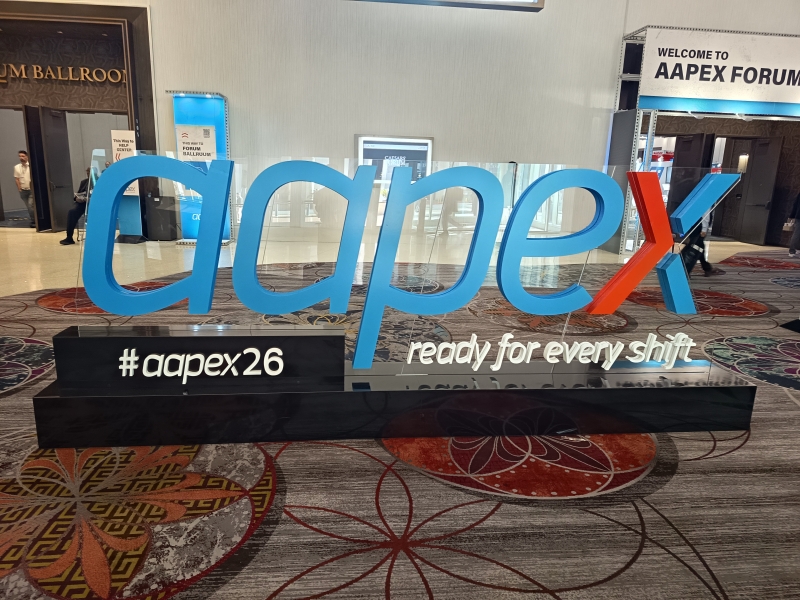
AAPEX week in Las Vegas brought together the people who run the aftermarket. Conversations during the show covered distributor and supplier CEOs, commercial leaders, private equity firms preparing their next funds, companies in turnaround and executives weighing their next move. One theme came through clearly: the aftermarket’s bottleneck has moved from parts to people.
The fundamentals are strong. The US light-vehicle aftermarket is forecast to grow 5.2% in 2026. The average US light vehicle is now 12.94 years old, and there were 354 aftermarket M&A deals in 2025, up from 306 in 2023.
5.2%
Forecast aftermarket growth, 2026
12.9 yrs
Average age of a US light vehicle
354
Aftermarket M&A deals in 2025
60%
Of aftermarket leaders expect demand to grow
Demand is not the problem
In AAPEX’s own 2026 survey of 448 aftermarket professionals, 60% expected demand to grow. Uncertainty was the top challenge, and attracting skilled talent was second.
The conversations at the show echoed that. None of the leaders were worried about demand. All of them were focused on their teams. The survey’s top two challenges are closely linked: uncertainty is far easier to manage when boards trust the people making the decisions.
The leadership squeeze
Three forces are converging in 2027. The industry is consolidating faster than it is integrating. The generation that built these businesses on relationships is nearing retirement. And the job itself is getting harder, with tariffs, resourcing and private equity’s pace all landing on the same leaders. Demand for executives who can handle all three is rising just as the supply is shrinking.
An acquisition is a transaction. Integration is a leadership job.
Here is what that looks like up close.
- 01
Consolidation has outrun integration. At one distributor, a string of acquisitions never truly came together: separate cultures, separate systems, and lost market share as a result. Others are cutting their footprint by more than half and running with leadership teams nearly half the size. An acquisition is a transaction. Integration is a leadership job, and many companies never staffed it.
- 02
Execution, not strategy, is the gap. Several CEOs described their plans as sound and their execution as the problem. The leaders getting traction have narrowed to two or three priorities with clear owners. Under PE ownership, tolerance for slow execution is gone, and leaders who can’t keep pace are replaced quickly.
- 03
Commercial leadership is the scarcest skill in the industry. Companies need leaders with real relationships across both warehouse distribution and retail, plus the category management discipline to grow share. One executive estimated that most of the existing team lacked the capabilities the business now needs. Another made the math plain: one strong category manager can win an order worth many times the salary. Commercial talent is a revenue line, not a cost line.
- 04
Supply chain has become a leadership seat. Tariff price recovery, resourcing away from China and customers diversifying their own suppliers came up in nearly every conversation. AAPEX’s survey found that 70% of aftermarket businesses have completed, planned or started supplier diversification. Companies are not just adding buyers. They are adding supply chain leaders who report to the CEO.
- 05
The succession wave is closer than boards think. Long-tenured leaders across the industry are approaching retirement, and the layer below them often isn’t ready. One CEO expects meaningful turnover on the leadership team within two years, with too few proven operating executives in the market to replace them. When several companies go looking for the same small pool at once, the ones that planned early win.
- 06
The next great leader may come from another industry. One PE-backed distributor hired its COO from aerospace. OE-supplier and industrial executives are moving into aftermarket and PE roles. Product knowledge can be learned. Operating discipline, integration experience and the ability to lead through change travel well across sectors.
- 07
The PE playbook has shifted. Valuations sit well below their 2021 peak and holds are running longer. Some boards have moved from M&A to restructuring, and a few businesses are in genuine turnaround. At the same time, debt maturities will put more businesses up for sale over the next two years, and many expect the next wave of national consolidation in late 2027 and 2028. Leaders who can integrate, restructure and grow will be in demand on both sides of that wave.
What the companies getting it right are doing
The contrast was clear. The businesses with momentum made their leadership moves before the pressure arrived. One added a supply chain leader and an outside COO ahead of consolidating its footprint, not after. Another tied its hiring plan directly to its growth budget, so the commercial roles were funded before the revenue was needed. Both treated leadership as part of the strategy, not a response to it.
What companies should do now
- 01
Build the team for the business you will be in 24 months. After the next acquisition, footprint change or recapitalization, the leadership requirements change. Assess your team against that business, not today’s.
- 02
Finish the integration before the next deal. Name an integration leader, agree on one operating model and one culture, and keep the acquired leaders the deal thesis depends on.
- 03
Narrow to two or three priorities. Give each an owner with real authority and a measure the board can see every quarter.
- 04
Fund commercial talent like a revenue investment. Upgrade sales, product and category management leadership, and prioritize leaders who cover both distribution and retail.
- 05
Put supply chain at the strategy table. Sourcing, resourcing and tariff recovery now drive margin. The leader who owns them belongs on the leadership team.
- 06
Start succession planning 12 to 18 months before you need it. Know your internal candidates, benchmark them against the external market, and decide early whether the next leader comes from inside or outside.
- 07
Widen the search. For operations, supply chain and turnaround roles, the strongest candidates may come from aerospace, OE or broader industrial businesses.
Three questions for your next board meeting
01If two of our top five leaders left in the next 18 months, who would step in, and are they ready?
02Is our leadership team built for the business we are today, or the one we plan to be after the next deal?
03Who owns commercial growth and supply chain risk, and do they have a seat where strategy is decided?
How MarVantage helps
MarVantage works on exactly these issues with aftermarket, OE, industrial and PE-backed leadership teams, and with the boards and sponsors behind them. Every engagement is founder-led, from the first conversation to the placement and beyond.
Succession planning. A market study of internal and external talent, an assessment against the business plan, and a clear view of what each critical role must deliver over the next 36 months.
Leadership team assessment. At acquisition, recapitalization or turnaround, a clear read on who can lead the next phase.
Executive search for critical roles. CEOs and presidents, COOs, and the commercial, operations and supply chain leaders who turn strategy into results.
Cross-sector reach. Knowing where proven operators sit in adjacent industries, and how to bring them into the aftermarket.
Demand will take care of itself in 2027. Leadership won’t. The companies that pull ahead will be the ones that build the team for the business they are becoming, before the next deal, the next retirement or the next tariff forces the decision.

Marisa Smith is Founder and Managing Partner of MarVantage, a founder-led executive search and leadership advisory firm. Our aftermarket expertise →